More Effective Cloud-Based Automated Analysis of Environmental Sensor Data
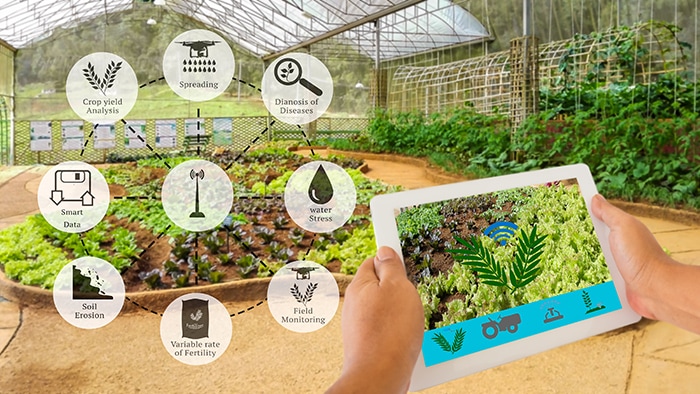
Image Source:
Montri Nipitvittaya/shutterstock.com
By Mark Patrick, Mouser Electronics
Published February 14, 2020
The Internet of Things (IoT) is now starting to see significant implementation, with tens of billions of nodes
expected to go into operation over the next few years. As widespread rollout begins in earnest, one of the major
uses of this technology will be the monitoring of different key environmental parameters—such as
temperature, air humidity, carbon monoxide levels, etc. Via this captured data, it will be possible to make
decisions and
identify appropriate actions to take. For example, let's consider a chemical processing plant. If the gas
content output from a chimney was to exceed a predetermined threshold, then it might be necessary to reduce the
level of processing activity at that time. Alternatively, it might be a sign of a longer-term trend that will
need addressing—perhaps the processing equipment involved requires maintenance, or has reached the end of
its working life and should be replaced altogether.
Finding an efficient way to carry out in-depth analysis on the vast quantities of data continuously being
acquired through the sensor devices incorporated into an expansive network of IoT nodes, then initiating an
appropriate reaction is not that simple. Although it might not present a challenge when there is just data
coming in from a small number of nodes, coping with the weight of numbers that an industrial control or
environmental monitoring system will have is something entirely different. This is equally applicable to a broad
spectrum of potential contexts, such as smart homes/buildings, factory automation, agriculture, smart cities,
etc.
To maximize efficiency and keep response times as short as possible, it will be necessary to put an automated
decision-making process in place—and this will call for the employment of advanced algorithms. Just
storing a
set of rules on a database then cross-referencing them against the data received isn't effective when you take
into account the sheer number of IoT nodes that are likely to be involved. Such an arrangement could quickly
become snowed under. A more sophisticated, yet streamlined, approach is therefore needed.
Some have concluded that the Rete algorithm is the key to this. Already applied to a vast array of business
cases, the Rete algorithm was first developed in the late 1970s. The core objective of the algorithm is to
provide a pattern-matching mechanism through which the vast quantities of pattern data—such as those that
IoT
networks are now starting to generate—can be rapidly compared against a database containing many different
objects. The need for data iteration is avoided, with the status of a particular pattern being kept in a memory
reserve throughout the process. The upshot of this is that there is no need to revert to rules that have been
applied previously—thereby accelerating the whole procedure and making it much more time-efficient than
alternative methodologies.
Operating in conjunction with
Silicon Labs' Thunderboard™ 2 sensor module and the
Raspberry Pi 3B+
(which is pre-loaded with Yocto Linux®),
UrsaLeo's cloud-based analysis software follows this tactic. The
UrsaLeo UL-RPI1S2R2
Raspberry
Pi Cloud Development Kit is designed to serve as a starting point for connecting static sensors to the
Google
Cloud. The kit sends data from nine sensors immediately to a Google Cloud account where it can be viewed and
processed.
The UrsaLeo UL-RPI1S2R2 enables captured data to be actioned by applying a tree-based rule structure for pattern
matching, rather than having to often refer to a lookup table. This ensures that better-informed decisions are
made
without adding unwanted latency to the system. Customized dashboards displaying the compiled datasets can be
accessed
and triggers set up to alert operatives if certain events occur for which human intervention will be required.
By using the intuitive visually based editor tool, a set of rules can be established that fully align with the
particular
application requirements. A trigger can be set every time a message is received, or conversely if a message has
not been
received within a specified period. Alternatively, a trigger can be initiated at regular intervals (after an
hour, a
day or a week has elapsed), for long-term monitoring purposes. A geofencing rule can also be
defined—triggering
when a mobile node moves outside/into a given area. This could be used to keep forklift trucks within
predetermined
confines on the factory floor, or in fleet management and livestock tracking applications. Furthermore, if a
captured
data value is unusual (e.g., it remains the same constantly or is permanently at zero), then it can suggest that
the
sensor is not operating correctly, and this can then be flagged so that an engineer can be sent out into the
field to
undertake any necessary repairs.
The Thunderboard 2 module can acquire environmental data from the wealth of different sensors that have been
incorporated—covering ambient light, air quality, barometric pressure, relative humidity, and temperature,
as well
as having scope for adding in gas-detection functions. A 6-axis inertial sensor (for space orientation) and a
Hall effect
sensor (for geographical orientation) are also encompassed. The accompanying Raspberry Pi board serves as an IoT
gateway
(interfacing directly with the Google Cloud platform). Through it, all the compiled data can be transferred back
to the
cloud via either its wireless (Wi-Fi®) or wireline (Ethernet) connectivity options. Depending on the
application
scenario, the hardware can be powered by USB or using a Li-ion coin cell battery.
The tree-based methodology employed means that this system is fully scalable, with the ability to attend to any
prospective
number of connected IoT nodes within a network, rather than being limited to a certain quantity. As a
consequence, it will
be possible for hundreds of thousands of events/alerts to be dealt with every second. Even with a medium-sized
server, the
system can process 500,000 messages per second, and this could be pushed up to 1 million to 2 million with a
high-capacity
server.
Figure 1: UrsaLeo IoT hardware—comprising a Thunderboard 2 module and
Raspberry Pi 3B+ (Source: Mouser Electronics)
Through the combination of highly optimized cloud-enabled hardware and superior algorithms, the way that IoT data
is handled
can be considerably more time-efficient than it is today. This will facilitate the ramp-up of IoT deployments to
a point
where there are hundreds of thousands of connected nodes involved—allowing the true benefits of this
technology
to be realized across various industry sectors.
 Part of Mouser's EMEA team in Europe,
Mark joined Mouser Electronics in July 2014 having previously held senior marketing roles at RS Components.
Prior to RS, Mark spent 8 years at Texas Instruments in Applications Support and Technical Sales roles and holds
a first class Honours Degree in Electronic Engineering from Coventry University.
Part of Mouser's EMEA team in Europe,
Mark joined Mouser Electronics in July 2014 having previously held senior marketing roles at RS Components.
Prior to RS, Mark spent 8 years at Texas Instruments in Applications Support and Technical Sales roles and holds
a first class Honours Degree in Electronic Engineering from Coventry University.