Maximizing Uptime and Profitability with Predictive Maintenance
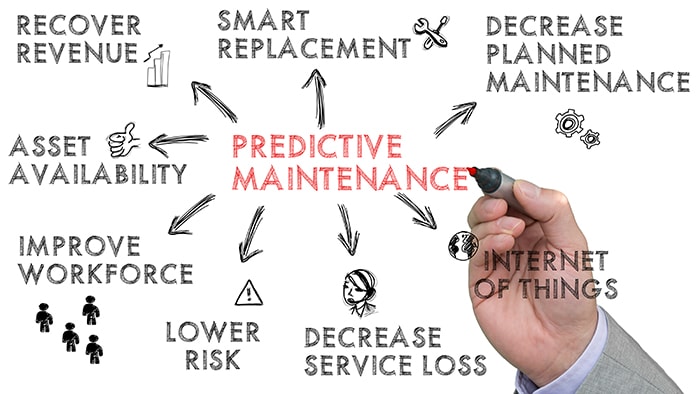
Image Source:
BeeBright/Shutterstock.com
By Paul Golata, Mouser Electronics
Published May 24, 2021
Despite being in great shape for my age and being very athletic for my mid-50s, my body cannot take the same
physical punishment I took when I was younger. I must spend more time resting between strenuous exertions. To
stay healthy, I must listen to my body’s sensory inputs and make the necessary adjustment to maintain
myself. I must eat well, get lots of sleep, and rest days while always paying real-time attention to what my
body is signaling. Technology, such as wearables devices and fitness apps, helps keep us informed of our bodies'
actions and warn us when our body is about to fail. This early intervention will help mitigate further damage to
our bodies.
Like the maintenance of human health, the desire of Industrial Internet of Things (IIoT) is that industrial
applications stay functioning and effective. Machine Health Monitoring (MHM) is concerned with keeping
mechanized assets running smoothly and efficiently. Industrial sensor data can be utilized to provide users with
an edge over others. Before an industrial system breaks, fails, or runs errant, information collected from
different sensors identifies and takes any needed action to correct potential anomalies. Whether in an
industrial building, a smart home, or a vehicle, these systems fuse countless sensor data to provide
intelligence at the edge. Let’s examine how predictive maintenance helps industry maximize uptime,
industrial agility, and profitability.
Two Ways: CdM and PdM
Maintenance is a process to preserve or extend the life of something. For IIoT applications, maintenance can be
measured and enacted in two broad and complementary categories. In either case, sensors and processors are key
electronic components needed to obtain the information and then transform it into useful intelligence gathered
from within the system. The first category is condition-based maintenance (CbM). CbM employs real-time sensor
measurements. The second primary category is predictive maintenance (PdM). In contrast to CdM, PdM does not
inherently rely on real-time information. Instead, it predicts future maintenance events.
Action Orientations
These two categories are distinguished mainly by approach and methodology. Neither is better; they complement
each other. In both categories, conditions are monitored. Monitoring can happen in three methods: continuous
real-time sensing, periodic interval sensing, or remote sensing.
CdM might be broadly considered to be reactive, and PdM might be viewed as proactive. CdM might require more
ongoing real-time sensors and thus might require more components, time, and data.
Industrial users generally wish to spot any potential problems sooner rather than later. The value or benefit of
this is obvious: Earlier detection helps reduce system downtime, improve operational runtimes and throughput
efficiencies, and minimize costly or significant repairs and safety issues. PdM is valuable because it saves
both money and time because maintenance only gets performed when necessary.
One caveat to keep in mind: PdM and CdM cannot solve all the issues, and this is because they can only be applied
to a selected subset of what is the use case. Human sensing and electronic sensing have different strengths and
weaknesses. Presently, not everything is sensed or connected into the IIoT. Likewise, specific failure modes are
outside the defined purview of what might be sensed or how that data is to be correctly interpreted. Another
issue is that the quantity of sensors at any given locale might be less than ideal because of factors such as
cost, environment, locational access, etc.
Over time, potential for errors of omission will diminish, but one should not expect predictive or preventive
actions to eliminate all failures. They will, however, work to reduce and mitigate failures by a significant
margin.
Benefits
Increase asset
- Availability
- Life
- Utilization
Reduce asset
- Capital replacement decision time
- Failure costs
- Failure frequency
- Maintenance costs
- Preventative maintenance
- Operational risks
- Safety risks
- Unplanned downtime
Predictions are projections about the future based upon empirical observations of the past. To potentially
accurately predict the future, any past information collected and employed to project a prediction must strongly
correlate with the future. If it does not, it is simply an unconnected speculation.
Take the case of a deck of 52 randomly shuffled playing cards. As the first several cards are dealt out, we know
of no strong correlation to indicatewhat might be dealt next. Only when one comes to the bottom of the deck will
the odds dramatically increase, indicating what card might likely be dealt next.
Based upon my past observational experiences, I can predict that if I let go of the pencil in my hand, it will
fall to the floor. I am making a statement about the future, a prediction. I have high confidence in this
prediction. This confidence comes from the fact that a pencil should fall to the floor if I am in the
earth’s gravitational field because I am not in outer space or in a context where I am expecting an
optical illusion or similar to occur. My conditional statement expressing this would be:
- If I drop a pencil,
- Then it will fall to the floor
The desired goal is to successfully achieve a predictive analytics model that provides a probability that informs
the maintenance process. From this goal follows the prevention of the failure by scheduling appropriate
corrective maintenance to remedy the situation and restore it to standard conditions.
PdM, AI, and IIoT
Successful PdM relies upon the IIoT. This is because the IIoT collects the actions of the machines and places
them into a digital format that can be transported and processed, aggregated, and analyzed. Wired and wireless
connectivity solutions provide sufficient bandwidth to handle large amounts of data. This allows a complete
model to be built at the edge or in the cloud.
Because the goal is to avoid asset breakdowns without warning, the ability to predict when maintenance should be
scheduled is imperative. To help make these predictions with higher confidence levels, artificial intelligence
(AI) is employed to assist with predicting because tiny changes can be analyzed very quickly. Reliability
engineers and maintenance managers will utilize AI to mimic human behavior, including decision-making, to
support PdM efforts (Figure 1).
Figure 1: Reliability engineers and maintenance managers will utilize
artificial intelligence to mimic human behavior, including decision making, to support PdM efforts. (Source:
Wright Studio/Shutterstock)
Sensory information from the system can be analyzed through machine-learning (ML) algorithms using advanced
analytics software. ML employs statistical methods (mathematics) to assist machines in learning by experience
(empirical observation). The machine learns concepts from these patterns in the data. ML gives computers the
ability to learn without being explicitly programmed. Sensors, AI/ML, and specialized software enable automated
preemptive corrective maintenance actions to be performed.
Sensing Technologies
Industrial items, including engines, motors, gears, compressors, turbines, and the like can be sensed for
information, such as temperature, vibration, humidity, sound and noise levels, rotational or linear velocity to
detect for wear or apparent anomalies. Infrared (IR) thermography is the process of using a thermal imager to
detect radiation from an object. IR cameras might be able to detect abnormalities in temperature. Temperature
measurements outside of normal can indicate a potential malfunction. IR cameras must be pointed at the correct
location and are generally expensive. Due consideration should be given to where they are most helpful. Acoustic
sensing and monitoring are useful for detecting leaks. Ultrasonic technology can be employed to detect
mechanical issues such as friction or stress. Vibration sensors pick up vibration patterns that indicate wear on
internal parts such as bearings and gears. It can also generate information related to rotational or linear
misalignments.
Remaining Useful Life
The remaining useful life (RUL) can be predicted based upon factors, including how long it took for similar items
to reach failure or known threshold value indicating status critical has been reached. AI and IoT combined allow
PdM to achieve a very high success rate in prediction. This combination maximizes productivity and asset life.
Electronic Components
Mouser Electronics offers a broad portfolio of products to help customers realize a PdM or CdM system. Our wide
selection of sensors comes from industry-leading manufacturers. Mouser is an authorized distributor for many
sensor manufacturers, including All Sensors, Amphenol, Analog Devices, Broadcom, Crouzet, Grayhill, Honeywell,
Infineon, Littelfuse, Maxim Integrated, NXP, Omron, Schneider Electric, TE Connectivity, Texas Instruments, and
TT Electronics. Our selection includes temperature sensors, pressure sensors, accelerometers, humidity sensors,
proximity sensors, and Hall Effect sensors.
In addition, Mouser offers a wide variety of semiconductors that support the motor control, power management,
processing, and wireless connectivity solutions commonly employed within these systems. Mouser also stocks and
supports specific solutions designed to address these markets. These include Omron Industrial
Automation Predictive Maintenance Solutions, Renesas Electronics IoT
Sensor Board with Machine Learning & BLE, and the STMicroelectronics
Predictive Maintenance & Monitoring Solution.
Conclusion
Predictive maintenance is here to stay. I am absolutely certain of it. While you and I will continue listening to
our bodies and responding accordingly, the synergies achieved through combinations of sensor data, IoT, AI, and
software analytics will provide industry the edge they need to address their systems before breaking, failing,
or running errant. PdM will help maximize uptime and profitability.
Author Bio
 Paul Golata joined Mouser Electronics in 2011. As a Senior Technical Content Specialist, Paul is accountable for
contributing to the strategic leadership, tactical execution, and overall product line marketing direction for
advanced technology related products. Paul provides design engineers with the newest and latest information
delivered through the creation of unique and valuable technical content that facilitates and enhances Mouser
Electronics as the preferred distributor of choice.
Paul Golata joined Mouser Electronics in 2011. As a Senior Technical Content Specialist, Paul is accountable for
contributing to the strategic leadership, tactical execution, and overall product line marketing direction for
advanced technology related products. Paul provides design engineers with the newest and latest information
delivered through the creation of unique and valuable technical content that facilitates and enhances Mouser
Electronics as the preferred distributor of choice.
Before Mouser Electronics, he served in various manufacturing, marketing, and sales related
roles for Arrow Electronics, JDSU, Balzers Optics, Piper Jaffray, Melles Griot, and Hughes Aircraft Company.
Paul
holds a BSEET from DeVry Institute of Technology—Chicago, IL; an MBA from Pepperdine
University—Malibu, CA; an MDiv w/BL from Southwestern Baptist Theological Seminary—Fort Worth, TX; and
a PhD from Southwestern Baptist Theological Seminary—Fort Worth, TX.