Wireless Mesh Networking Topology
View All Wireless and Mesh Networking
Products
Comparison of Network Types
Topology
|
Reliability
|
Adaptability
|
Scalability
|
Mesh Networks
|
High
|
High
|
Yes (thousands of end points)
|
Point-to-Multipoint
|
Low
|
Low
|
Moderate (7-30 end points)
|
Point-toPoint
|
High
|
Low
|
None (Two end points)
|
Mesh Network

Point-to-Multipoint

Point-to-Point

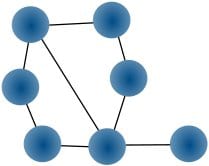
Mesh network topology is a key network architecture in which devices are connected with many
redundant interconnections between network nodes. If any batteries or nodes fail in a wireless mesh topology,
many other ways are available for two nodes to communicate. A mesh topology is often used in conjunction with other
topologies – such as Star, Ring, and Bus – to form a hybrid topology. Some WAN architecture, such as the Internet,
employs mesh routing. This allows the Internet sites to communicate even during a war.
The two types of mesh topologies are full mesh and partial mesh.
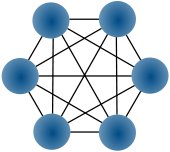
Full mesh topology occurs when every node has a circuit connecting it to every other node in a network. Full mesh
yields the greatest amount of redundancy, so if a node fails, network traffic can be directed to any of the other
nodes. Full mesh is usually reserved for backbone networks. With partial mesh, some nodes are organized in
a full-mesh scheme, but others are connected to only one or two in the network. Partial mesh topology
is commonly found in peripheral networks connected to a full meshed backbone. Partial mesh is less expensive to
implement but yields less redundancy than full mesh topology.
Full Mesh Network
 Partial Mesh Network