Pressure Sensors for Two-Stage AHU Controllers
 A
pressure sensor
measures pressure, typically of gases or liquids. Pressure is an expression of the force
required to stop a fluid from expanding, and is usually stated in terms of force per unit area.
A pressure sensor transducer generates an electronic signal as a function of the pressure
imposed. Pressure sensors are used for control and monitoring in thousands of everyday
applications. Pressure sensors can also be used to indirectly measure other variables such as
fluid/gas flow, speed, fluid level, and altitude.
Pressure sensors
can alternatively be called pressure transducers, pressure transmitters, pressure senders,
pressure indicators, piezometers, and manometers, among other names. Pressure sensors can vary
drastically in technology, design, performance, application suitability and cost. A special
category of pressure sensors can dynamically measure very high speed changes in pressure.
Example applications are combustion pressure in an engine cylinder or in a gas turbine. These
sensors are commonly manufactured out of piezoelectric materials such as quartz .
A
pressure sensor
measures pressure, typically of gases or liquids. Pressure is an expression of the force
required to stop a fluid from expanding, and is usually stated in terms of force per unit area.
A pressure sensor transducer generates an electronic signal as a function of the pressure
imposed. Pressure sensors are used for control and monitoring in thousands of everyday
applications. Pressure sensors can also be used to indirectly measure other variables such as
fluid/gas flow, speed, fluid level, and altitude.
Pressure sensors
can alternatively be called pressure transducers, pressure transmitters, pressure senders,
pressure indicators, piezometers, and manometers, among other names. Pressure sensors can vary
drastically in technology, design, performance, application suitability and cost. A special
category of pressure sensors can dynamically measure very high speed changes in pressure.
Example applications are combustion pressure in an engine cylinder or in a gas turbine. These
sensors are commonly manufactured out of piezoelectric materials such as quartz .
A conservative estimate is that there are over 50 technologies and at least 300 companies making
pressure sensors worldwide.
CO
2
Sensors for Two-Stage AHU Controllers
 A
carbon dioxide
(
CO2
)
sensor
measures the concentration of CO2 in the surrounding air. CO2 is an
asphyxiant, and as such it is often monitored carefully in high-density indoor environments. The
U.S. Occupational Safety and Health Administration (OSHA), among other agencies and
organizations, have set an upper limit of 5000 ppm for an 8-hour work day, although adverse
health effects may be noticed at as little as half this value.
A
carbon dioxide
(
CO2
)
sensor
measures the concentration of CO2 in the surrounding air. CO2 is an
asphyxiant, and as such it is often monitored carefully in high-density indoor environments. The
U.S. Occupational Safety and Health Administration (OSHA), among other agencies and
organizations, have set an upper limit of 5000 ppm for an 8-hour work day, although adverse
health effects may be noticed at as little as half this value.
The two most common technologies are Nondispersive Infrared (NDIR) sensors, which measure
CO2 spectroscopically, and chemical based sensors. The latter has greater problems
with sensor drift and relatively low service life, but can often be smaller, lower cost, and
more power efficient.
Air Flow Sensors for Two-Stage AHU Controllers
 Air flow sensors
are devices that measure the volume or mass of air passing through a given area per unit time.
One of the most common of these sensors measure air flow using thermal-based sensing. Greater
air flow causes faster cooling of a thin wire or film which is heated above the ambient air
temperature. As air flow increases, more current must be passed through the heated object to
maintain a constant temperature. Together with a bridge circuit and thermistor (to compensate
for variations in air temperature), the sensor is capable of measuring
air flow
with high precision and fast response time.
Air flow sensors
are devices that measure the volume or mass of air passing through a given area per unit time.
One of the most common of these sensors measure air flow using thermal-based sensing. Greater
air flow causes faster cooling of a thin wire or film which is heated above the ambient air
temperature. As air flow increases, more current must be passed through the heated object to
maintain a constant temperature. Together with a bridge circuit and thermistor (to compensate
for variations in air temperature), the sensor is capable of measuring
air flow
with high precision and fast response time.
Temperature Sensors for Two-Stage AHU Controllers
 In electronics, silicon bandgap sensors are among the most common for highly accurate
temperature measurements
over a relatively small range. The technology is based on the principle that as the temperature
of a silicon diode increases, the forward voltage of the diode increases proportionally. This
method is generally very low cost, allowing the
sensor
to be built into an integrated circuit. Because air temperature regulation is major function of
most HVAC systems, accurate and reliable temperature sensors are often essential to HVAC design.
In electronics, silicon bandgap sensors are among the most common for highly accurate
temperature measurements
over a relatively small range. The technology is based on the principle that as the temperature
of a silicon diode increases, the forward voltage of the diode increases proportionally. This
method is generally very low cost, allowing the
sensor
to be built into an integrated circuit. Because air temperature regulation is major function of
most HVAC systems, accurate and reliable temperature sensors are often essential to HVAC design.
Relative Humidity & Temperature Sensors for Two-Stage AHU Controllers
 A
Relative Temperature and Humidity
(
RT&H
)
sensor
is a combination of both a thermometer and a hygrometer. Relative humidity sensors (hygrometers)
measure the amount of moisture present in the air. Capacitive humidity sensors are some of the
most common; the dielectric polymer of a sensing capacitor absorbs and releases water as
relative humidity rises and falls, effectively changing the measured capacitance. These sensors
can be important for an Air Handling Unit (AHU), as an AHU may include a humidifier and/or
de-humidifier for ensuring an appropriate indoor humidity.
A
Relative Temperature and Humidity
(
RT&H
)
sensor
is a combination of both a thermometer and a hygrometer. Relative humidity sensors (hygrometers)
measure the amount of moisture present in the air. Capacitive humidity sensors are some of the
most common; the dielectric polymer of a sensing capacitor absorbs and releases water as
relative humidity rises and falls, effectively changing the measured capacitance. These sensors
can be important for an Air Handling Unit (AHU), as an AHU may include a humidifier and/or
de-humidifier for ensuring an appropriate indoor humidity.
Because relative humidity is a function of both temperature and absolute humidity, these devices
must either include a temperature sensor or implement some form of temperature compensation. In
electronics, silicon bandgap sensors are among the most common for highly accurate temperature
measurements over a relatively small range. The technology is based on the principle that as the
temperature of a silicon diode increases, the forward voltage of the diode increases
proportionally. This method is generally very low cost, allowing the sensor to be built into an
integrated circuit. Because air temperature regulation is a major function of most HVAC systems,
accurate and reliable temperature sensors are often essential to HVAC design.
Hall Effect Sensors for Two-Stage AHU Controllers
 Hall Effect sensors
are magnetically biased transducers that vary output voltage or current in response to changes
in a magnetic field. Hall Effect sensors can be designed to sense rotary movement of a motor
shaft. The rotation of the motor shaft changes the IC's position with respect to the magnets,
and thus detects the change in flux density. The output of the IC is converted to a linear
output over 90 degrees of shaft travel. The Hall Effect sensor gets its name from Edwin Hall,
who, in 1879 discovered that a voltage difference can be produced across an electrical conductor
where the magnetic field is perpendicular to the direction of current flow.
Hall Effect sensors
are magnetically biased transducers that vary output voltage or current in response to changes
in a magnetic field. Hall Effect sensors can be designed to sense rotary movement of a motor
shaft. The rotation of the motor shaft changes the IC's position with respect to the magnets,
and thus detects the change in flux density. The output of the IC is converted to a linear
output over 90 degrees of shaft travel. The Hall Effect sensor gets its name from Edwin Hall,
who, in 1879 discovered that a voltage difference can be produced across an electrical conductor
where the magnetic field is perpendicular to the direction of current flow.
Amplifiers for Two-Stage AHU Controllers
 Amplifiers
have enormous voltage gain, use feedback to operate, and can be classified in different ways.
They can be identified by the device they are intended to drive (e.g., headphone amplifier,
speaker amplifier), the input that they are to amplify (e.g. guitar amplifier), the frequency
range of the signal (e.g., RF, Audio), and by the function that they perform (e.g. inverting
amplifier, power amplifier.)
Amplifiers
have enormous voltage gain, use feedback to operate, and can be classified in different ways.
They can be identified by the device they are intended to drive (e.g., headphone amplifier,
speaker amplifier), the input that they are to amplify (e.g. guitar amplifier), the frequency
range of the signal (e.g., RF, Audio), and by the function that they perform (e.g. inverting
amplifier, power amplifier.)
Analog-to-Digital Converters for Two-Stage AHU Controllers
 An
Analog-to-Digital Converter
(
ADC
or A/D converter) measures the magnitude of an input analog signal and converts it to a digital
number that is proportional to the magnitude of the voltage or current. An ADC often converts
signals collected from the real-world to digital signals for processing. One of the more
important specifications of an ADC is the resolution that it offers, which is the number of
discrete values (represented in bits) that the ADC produces in relation to the analog signal it
is converting. The more bits, the higher the resolution. A higher resolution yields a more
accurate approximation of the analog input.
An
Analog-to-Digital Converter
(
ADC
or A/D converter) measures the magnitude of an input analog signal and converts it to a digital
number that is proportional to the magnitude of the voltage or current. An ADC often converts
signals collected from the real-world to digital signals for processing. One of the more
important specifications of an ADC is the resolution that it offers, which is the number of
discrete values (represented in bits) that the ADC produces in relation to the analog signal it
is converting. The more bits, the higher the resolution. A higher resolution yields a more
accurate approximation of the analog input.
Reference Voltage ICs for Two-Stage AHU Controllers
 A
voltage reference
produces a constant level of voltage over time regardless of load, changes in power supply, or
temperature. Voltage references are used in power supplies, analog-to-digital converters,
digital-to-analog converters, and many other applications where voltage levels must be
maintained at a steady level. Without a voltage reference, precision is greatly affected and may
render the device inoperable. Voltage references can vary greatly in performance. A voltage
reference for a power supply might hold its output to within only a few percentage points off of
its nominal or stated value; however, a voltage reference to instrumentation-level standards are
measured in parts per million regarding stability and precision to the nominal or specified
value.
A
voltage reference
produces a constant level of voltage over time regardless of load, changes in power supply, or
temperature. Voltage references are used in power supplies, analog-to-digital converters,
digital-to-analog converters, and many other applications where voltage levels must be
maintained at a steady level. Without a voltage reference, precision is greatly affected and may
render the device inoperable. Voltage references can vary greatly in performance. A voltage
reference for a power supply might hold its output to within only a few percentage points off of
its nominal or stated value; however, a voltage reference to instrumentation-level standards are
measured in parts per million regarding stability and precision to the nominal or specified
value.
Multiplexers for Two-Stage AHU Controllers
 A
multiplexer
(or MUX) is an electronic device with multiple inputs (analog or digital) from which it can
select one to forward as an output. In other words, a
MUX
allows a circuit to switch between inputs for a signal line. A MUX can reduce cost and part
count in many applications by enabling multiple signals to "time-share" a single resource, such
as an Analog-to-Digital Converter (ADC) or a microprocessor.
A
multiplexer
(or MUX) is an electronic device with multiple inputs (analog or digital) from which it can
select one to forward as an output. In other words, a
MUX
allows a circuit to switch between inputs for a signal line. A MUX can reduce cost and part
count in many applications by enabling multiple signals to "time-share" a single resource, such
as an Analog-to-Digital Converter (ADC) or a microprocessor.
Processors for Two-Stage AHU Controllers
 The term "
processor
" refers to an electronic device that performs computational functions and carries out the
instructions of a stored program. Other terms for processor are microprocessor, central
processing unit, and digital signal processor. Essentially, the processor refers to "the brains
of a computer."
The term "
processor
" refers to an electronic device that performs computational functions and carries out the
instructions of a stored program. Other terms for processor are microprocessor, central
processing unit, and digital signal processor. Essentially, the processor refers to "the brains
of a computer."
ZigBee Wireless Modules for Two-Stage AHU Controllers
 Zigbee
is a specification for communication in wireless personal area networks (WPANs) and is designed
for low-power, cost-efficient, and low duty cycle applications. Built upon the IEEE 802.15.4
standard, Zigbee adds both routing and multi-hop functionality. Star networks as well as
peer-to-peer (e.g., mesh and cluster tree) are supported, making Zigbee networks dynamic,
scalable, and decentralized. These qualities and more make Zigbee an excellent technology for
applications like home/industrial automation, Industrial Applications monitoring, and HVAC
control.
Zigbee
is a specification for communication in wireless personal area networks (WPANs) and is designed
for low-power, cost-efficient, and low duty cycle applications. Built upon the IEEE 802.15.4
standard, Zigbee adds both routing and multi-hop functionality. Star networks as well as
peer-to-peer (e.g., mesh and cluster tree) are supported, making Zigbee networks dynamic,
scalable, and decentralized. These qualities and more make Zigbee an excellent technology for
applications like home/industrial automation, Industrial Applications monitoring, and HVAC
control.
USB Transceivers for Two-Stage AHU Controllers
 USB
is a standard connection interface between computers and digital devices. A USB transceiver is a
physical layer device that prepares data for transmission and then sends to, and receives data
from, another transceiver. The transceiver detects connection and provides the low level USB
protocol and signaling. The term "transceiver" indicates an implementation of both transmit and
receive functions. It transmits and receives, encodes and decodes data, provides error
indication, implements buffers to stage data until it can be managed, and adjusts for the clock
rate from the serial stream on the
USB SuperSpeed bus
to match that of the link layer higher up on the communication stack.
USB
is a standard connection interface between computers and digital devices. A USB transceiver is a
physical layer device that prepares data for transmission and then sends to, and receives data
from, another transceiver. The transceiver detects connection and provides the low level USB
protocol and signaling. The term "transceiver" indicates an implementation of both transmit and
receive functions. It transmits and receives, encodes and decodes data, provides error
indication, implements buffers to stage data until it can be managed, and adjusts for the clock
rate from the serial stream on the
USB SuperSpeed bus
to match that of the link layer higher up on the communication stack.
RS-232 Transceivers for Two-Stage AHU Controllers
 RS-232
refers to a set of standards for single-ended serial communication, and covers such things as
logic voltage levels, timing, signal rate, and physical characteristics of the connectors. An
RS-232 port was once the standard interface for connecting a personal computer with peripherals
such as keyboards and modems, but has since been largely replaced by USB. It continues to be
used in other areas however; much of today's industrial automation equipment incorporates
RS-232.
RS-232
refers to a set of standards for single-ended serial communication, and covers such things as
logic voltage levels, timing, signal rate, and physical characteristics of the connectors. An
RS-232 port was once the standard interface for connecting a personal computer with peripherals
such as keyboards and modems, but has since been largely replaced by USB. It continues to be
used in other areas however; much of today's industrial automation equipment incorporates
RS-232.
Ethernet Transceivers for Two-Stage AHU Controllers
 Ethernet
is the most commonly used technology for non-wireless local area networks (LANs). Ethernet
controllers perform the function of interfacing computers and other electronic devices in a
network. Ethernet itself only defines the physical (PHY) and datalink (MAC) layers of the OSI
Model; however, processors with integrated Ethernet controllers can provide additional functions
such as a TCP/IP protocol stack.
Ethernet
is the most commonly used technology for non-wireless local area networks (LANs). Ethernet
controllers perform the function of interfacing computers and other electronic devices in a
network. Ethernet itself only defines the physical (PHY) and datalink (MAC) layers of the OSI
Model; however, processors with integrated Ethernet controllers can provide additional functions
such as a TCP/IP protocol stack.
Relay Drivers for Two-Stage AHU Controllers
 Designers of power electronic circuits must often drive power switches that feed DC, AC, or
power signals to a variety of workloads. Logic-level electronic circuits provide the driving
signals. In general, however, the power sources and their loads have reference levels different
from that of the control circuitry (ground). MOSFET selection begins by choosing devices that
can handle the required current, then giving careful consideration to thermal dissipation in
high current applications.
Designers of power electronic circuits must often drive power switches that feed DC, AC, or
power signals to a variety of workloads. Logic-level electronic circuits provide the driving
signals. In general, however, the power sources and their loads have reference levels different
from that of the control circuitry (ground). MOSFET selection begins by choosing devices that
can handle the required current, then giving careful consideration to thermal dissipation in
high current applications.
Digital Potentiometers for Two-Stage AHU Controllers
 A potentiometer can be understood as an adjustable voltage divider or a variable resistor. A
digital potentiometer
is a potentiometer that can be controlled with a digital signal. This allows the device to be
electronically adjusted by an MCU or processor and can provide a simple, cost-effective way to
implement digital-to-analog conversion. Many digital potentiometers are made using a resistor
ladder IC, such as the common R-2R ladder. There are a number of options when choosing a digital
potentiometer, such as resolution, number of taps, linear or log taper, non-volatile memory
options, and I/O interfaces.
A potentiometer can be understood as an adjustable voltage divider or a variable resistor. A
digital potentiometer
is a potentiometer that can be controlled with a digital signal. This allows the device to be
electronically adjusted by an MCU or processor and can provide a simple, cost-effective way to
implement digital-to-analog conversion. Many digital potentiometers are made using a resistor
ladder IC, such as the common R-2R ladder. There are a number of options when choosing a digital
potentiometer, such as resolution, number of taps, linear or log taper, non-volatile memory
options, and I/O interfaces.
Interface ESD for Two-Stage AHU Controllers
 If you have ever been zapped by a socks-wearing kid who has just discovered static charge build
up, you have experienced ESD first hand. ESD is like a miniature, localized lightning bolt
caused by an electrical discharge. ESD can have seriously damaging effects on an integrated chip
or system, or can cause poor performance or failure later on by merely weakening the circuits.
If you have ever been zapped by a socks-wearing kid who has just discovered static charge build
up, you have experienced ESD first hand. ESD is like a miniature, localized lightning bolt
caused by an electrical discharge. ESD can have seriously damaging effects on an integrated chip
or system, or can cause poor performance or failure later on by merely weakening the circuits.
Ethernet ESD for Two-Stage AHU Controllers
 If you have ever been zapped by a socks-wearing kid who has just discovered static charge build
up, you have experienced ESD first hand. ESD is like a miniature, localized lightning bolt
caused by an electrical discharge. ESD can have seriously damaging effects on an integrated chip
or system, or can cause poor performance or failure later on by merely weakening the circuits.
If you have ever been zapped by a socks-wearing kid who has just discovered static charge build
up, you have experienced ESD first hand. ESD is like a miniature, localized lightning bolt
caused by an electrical discharge. ESD can have seriously damaging effects on an integrated chip
or system, or can cause poor performance or failure later on by merely weakening the circuits.
Electromechanical Relays for Two-Stage AHU Controllers
 Simply put, a relay is an electrical switch that is controlled electrically. Relays are often
necessary to control high power/current/voltage circuits with a low-power signal while
maintaining complete electrical isolation between them.
Simply put, a relay is an electrical switch that is controlled electrically. Relays are often
necessary to control high power/current/voltage circuits with a low-power signal while
maintaining complete electrical isolation between them.
Many relays are electromechanical in nature; the control signal energizes an electromagnetic
coil creating a magnetic field. This field exerts a force on a movable armature of ferromagnetic
material (such as iron) which makes or breaks the electrical connection.
Solid State Relays (SSRs) are another common type, and unlike their electromechanical
equivalent, they have no moving parts. Instead, one or more transistors, such as a MOSFET, are
used to provide a similar function. Electrical isolation must be added in this case, often by
using an on-chip optocoupler.
USB Receptacles for Two-Stage AHU Controllers
 USB plugs
and
receptacles
are designed to reduce human error by their unique shape; they fit together in only one way. USB
plugs and receptacles are Type A (connecting to hosts or hubs) or Type B (connecting to devices)
and are available 3 sizes: standard, mini, and micro. Type A plugs always face upstream, Type B
faces downstream. USB is used in many applications covering all areas of electronics that
require communication, but more commonly with devices that need fast or easy connections for
interaction with computers. Since USB provides a small charging current as well, it is becoming
a de facto standard for charging portable devices.
USB plugs
and
receptacles
are designed to reduce human error by their unique shape; they fit together in only one way. USB
plugs and receptacles are Type A (connecting to hosts or hubs) or Type B (connecting to devices)
and are available 3 sizes: standard, mini, and micro. Type A plugs always face upstream, Type B
faces downstream. USB is used in many applications covering all areas of electronics that
require communication, but more commonly with devices that need fast or easy connections for
interaction with computers. Since USB provides a small charging current as well, it is becoming
a de facto standard for charging portable devices.
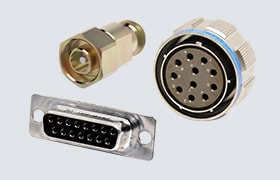
D-SUB Connectors for Two-Stage AHU Controllers
 A D-sub or "D-Subminiature Connector"contains two or more parallel rows of pins or sockets,
usually surrounded by a D-shaped metal shield that provides mechanical support, ensures correct
orientation, and may screen against electromagnetic interference. The part containing pin
contacts is called the male connector or plug, while that containing socket contacts is called
the female connector or socket.
A D-sub or "D-Subminiature Connector"contains two or more parallel rows of pins or sockets,
usually surrounded by a D-shaped metal shield that provides mechanical support, ensures correct
orientation, and may screen against electromagnetic interference. The part containing pin
contacts is called the male connector or plug, while that containing socket contacts is called
the female connector or socket.
RJ-45 Connectors for Two-Stage AHU Controllers
 RJ-45
connectors are a type of electrical connector commonly used for Ethernet jacks. The term "RJ-45"
is something of a misnomer, but it almost always refers to an 8P8C (eight position, eight
contact) modular connector with wiring pin-outs compatible with standard Ethernet.
RJ-45
connectors are a type of electrical connector commonly used for Ethernet jacks. The term "RJ-45"
is something of a misnomer, but it almost always refers to an 8P8C (eight position, eight
contact) modular connector with wiring pin-outs compatible with standard Ethernet.